Look up at the night sky. Every galaxy you can see is moving away from us. Not because we are at the centre of something, but because space itself is stretching.
Edwin Hubble confirmed this in 1929, and it changed cosmology forever. The universe is not static. It is growing. And that raises one of the strangest questions in all of science: what is it expanding into?
The Answer Is Nothing — And That Is Not a Contradiction
The universe is not expanding into empty space waiting to be filled. Space itself is what is expanding. The distinction matters more than it might seem.
Think of dots drawn on a balloon. As the balloon inflates, every dot moves away from every other dot. They are not travelling across the surface – the surface itself is getting bigger. There is no destination. No edge being reached. Just more surface, everywhere, all at once.
The universe works the same way. There is no outer boundary, no empty container it is growing into. Space is not moving through something else. It is simply becoming more of itself.
How We Know This
Hubble’s key observation was that distant galaxies show a redshift — their light is stretched to longer wavelengths, the same way a sound drops in pitch as its source moves away. The further the galaxy, the greater the redshift. The greater the redshift, the faster it is receding.
This pattern held in every direction Hubble looked. The universe was not collapsing, not stable, not cycling. It was expanding uniformly outward from every point simultaneously — which only makes sense if space itself is the thing doing the stretching.
The cosmos is all that is, or ever was, or ever will be.
Carl Sagan
It Is Also Speeding Up
This is where it gets even harder to accept. The expansion is not slowing down under the pull of gravity, as most physicists once expected. It is accelerating.
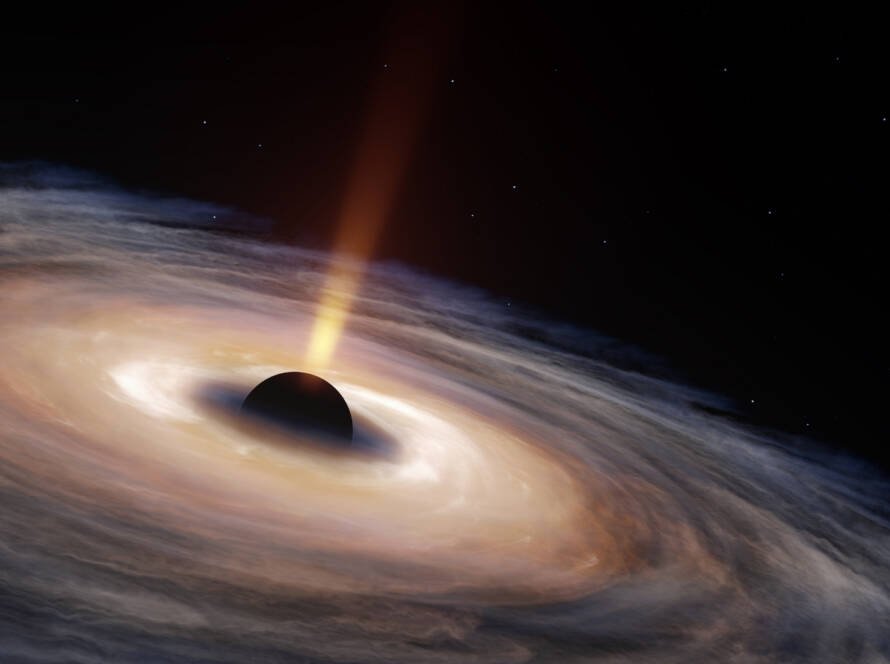
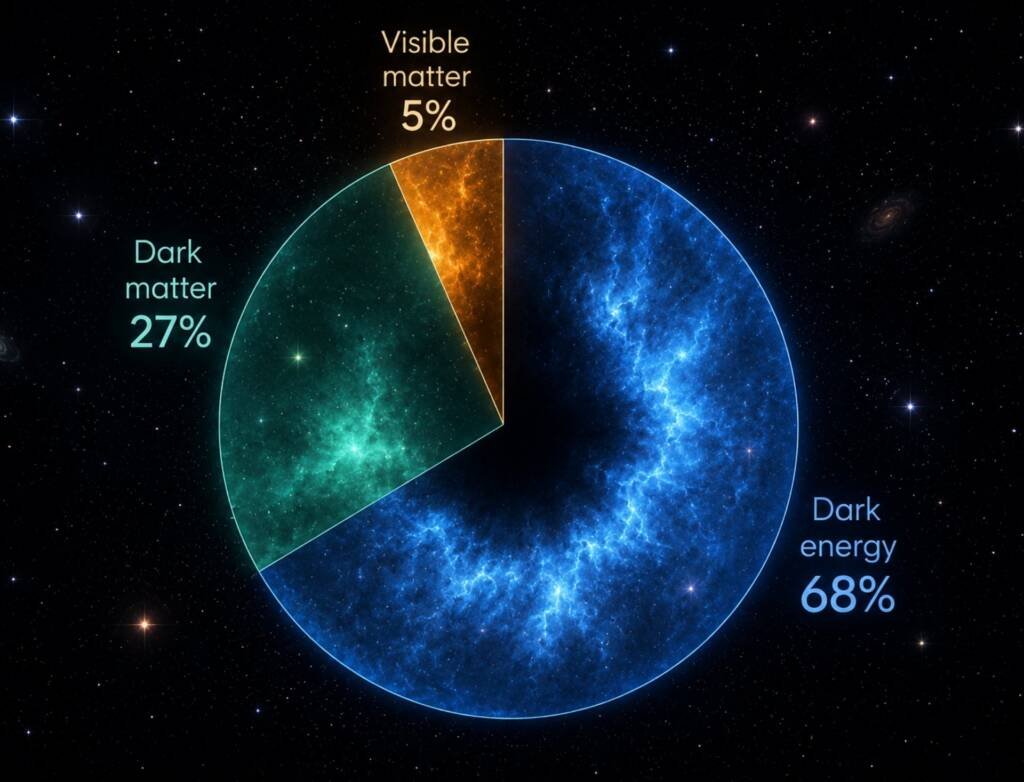
Something is pushing galaxies apart faster and faster. Scientists call it dark energy — a placeholder name for a force we have detected through its effects but cannot yet explain at a fundamental level. Current estimates suggest dark energy makes up roughly 68% of the total content of the universe.
We do not know what it is.
That is not a comfortable sentence for a science publication to write. But it is an honest one. The most dominant force in the universe is one we cannot see, cannot measure directly, and cannot yet explain. We know it exists because without it, the numbers do not add up.
Why This Should Fascinate You
The universe is expanding, accelerating, and mostly composed of things we do not yet understand. Dark energy alone accounts for more than two thirds of everything. Dark matter adds another 27%. The ordinary matter that makes up stars, planets, and every living thing represents just 5% of the universe’s total content.
We are, in the most literal sense, a small footnote in a story we have barely started reading.
The more precisely we map the cosmos, the larger the mystery becomes. And that is exactly what makes it worth studying.